
Social Interaction in Virtual Environments – SVR
Immersive Virtual Social Interaction in spatial realities offers many new opportunities such as customer contact points with seller-avatars or AI-based agents, virtual team meetings and training sessions, social inspection of digital twins of complex products, collaboration around virtual 3D objects or 2D canvases, therapeutical sessions to fight anxieties. These scenarios also pose novel research questions: How are people positioning? Do people trust virtual agents? Can teams build a joint team identity and emotional relationships in a virtual space? And much more.
At Spatialytix.org we work on a framework to explore such scenarios and study them. This involves a systematic exploration of possible use cases, a conceptual framework to guide the design of virtual social interaction and a technical framework for creating re-usable and configurable virtual interaction experiences. This website gives a short overview about this work.
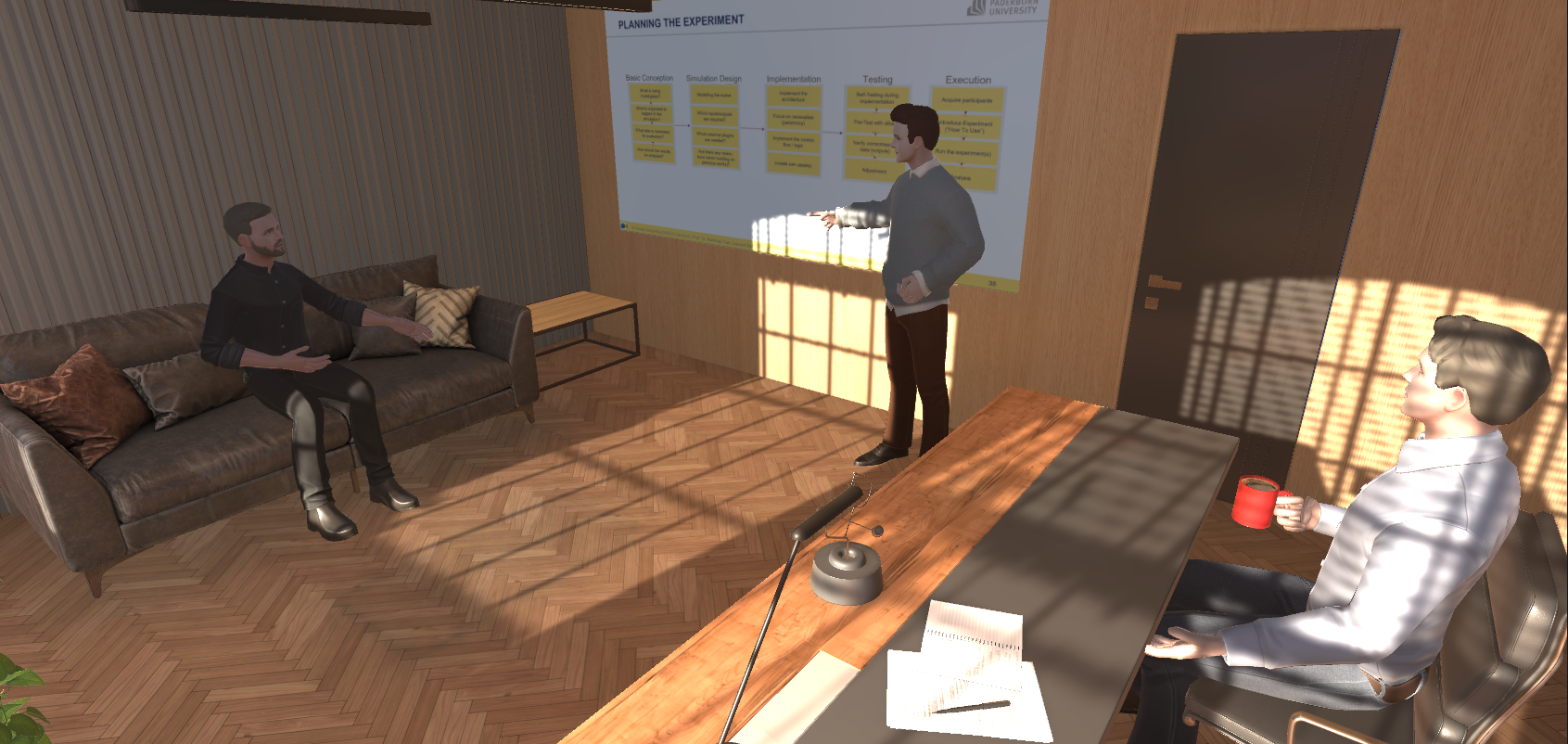
Application Scenarios for immersive Virtual Interaction
Virtual interactions can support many contexts, such as marketing, virtual onboarding, training, team collaboration, product development or therapies. Designing such experiences requires researching
user behaviours and perceptions.
Example: E-Health and Therapeutics
Reducing Speaking Anxiety: Research on Influence of Audience Gaze on Speaker’s Anxiety Levels
Example: Moderated Meeting / Educational Training
Using spatial team exercises to increase team identity and performance: Research on the influence of spatial exploration on social presence and recall
Example: Customer Relationship Management (VR Commerce)
Immersive Sales & Service Offerings: Research into influence of avatar features on avatar presence and customer trust and customer satisfaction levels
E-Health User Objectives
Anxiety Reduction, Stress Relief, Remote Health Consultation
Moderated Meeting User Objectives
Training supervised physical tasks, Interactive Information research using an agent
CRM Customer/User Objectives
Brand-related social experiences (e.g. interacting with virtual celebrities), informing about complex products, interactive customer service
Developing Conceptual and Technical Design Frameworks
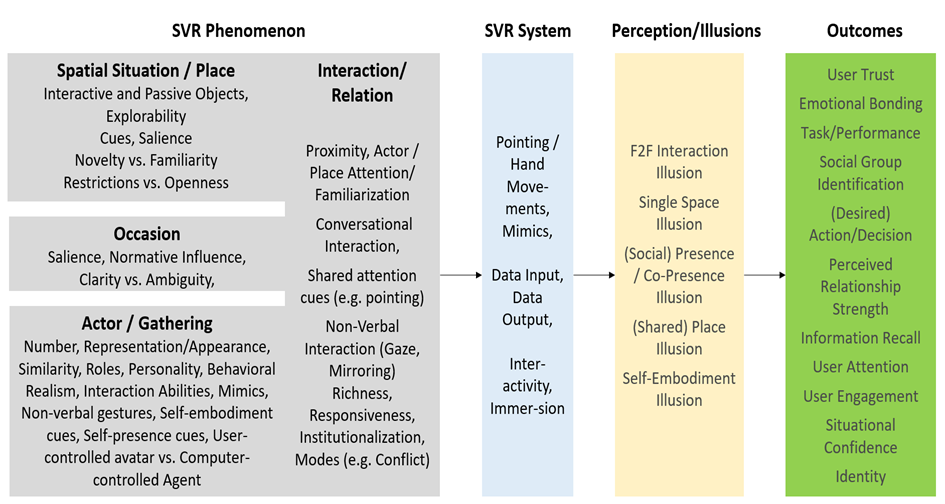
Social Virtual Interaction Design is very complex due to the overwhelming degrees of freedom. Based on prototyping, experimenting and practice, our team continuously evolves design frameworks on a theoretical/conceptual level but also on a technical level, as a Unity-based software project, for others to configure and re-use.
Conceptual Design Framework for Virtual Social Interaction Environments
- Theory-based Model of main Design Categories based on Interactionist Theories
- Literature-based Definition of Key theoretical concepts
- Design-Science compliant design process model
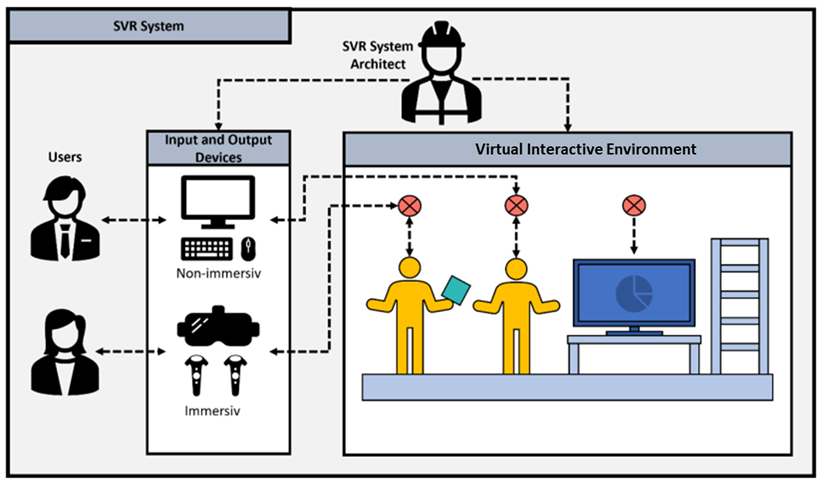
Unity-based Software Framework
- Reusable Unity Project that can be adapted
- Generalized Architecture to cover different interaction scenarios
- Tested in various experiments and constantly evolving
„We need a systematic approach to study the many varieties of immersive virtual social interaction – both on the conceptual and the technical levels.“
Prof. Matthias Trier
Chair at UPB and Group Leader Spatialytix.org
Getting upates – getting in contact
Contact us at: info@spatialytix.org
Subscribe our Newsletter